Ladder style value transformers for LLM fine tuning
Introduction
Some of the earliest applications of RL to LLMs with RLHF were based on PPO, with InstructGPT being explicitly PPO-based. Since then, GRPO has removed the critic and popularized LLM RL reasoning training at scale, becoming the dominant baseline. More recently, the literature has split between a “critic-free is enough” camp (GRPO, RLOO, and GSPO) and a “bring the critic back” camp (VC-PPO, VAPO, AsyPPO mini-critics, and GenAC).
The thesis of this post is that early LLM PPO implementations were limited by the quality of their value estimates, but value approximation itself remains a promising technique if the architecture can make value prediction cheap and accurate.
GRPO has the advantage of not requiring a critic, but it can only generate a sequence-level baseline, and it does so at the cost of sacrificing prompt diversity. Actor-critic methods are proven in other domains of RL, and GRPO struggles in comparison to PPO on classic RL environments. LLM reasoning is commonly formalized as a contextual bandit, but increasingly agents are used in complex multi-step environments with uncertainty over environment state. These practical environments could be treated as bandits, but this sacrifices their temporal structure. GRPO structurally assumes the bandit framing with its single scalar advantage per rollout. Value-approximation-based methods can calculate the value for any partial sequence, utilize bootstrapping, and take advantage of the temporal structure of the POMDP.
My experiment fine-tunes Qwen3 on Wordle using a small transformer-based value function that consumes representations from the base model at multiple layers. This architecture provides a critic that adds little overhead compared with the policy update while providing a more granular baseline than sequence-level group normalization. Bootstrapping is shown to outperform Monte Carlo returns with this critic architecture. PPO with this method is able to train Qwen3-4B-Instruct-2507 from a 1% solve rate on Wordle to 99% in 11 hours on an RTX 5090 GPU with no SFT warmup and no KL penalty against a reference policy. GRPO, by contrast, fails to push solve rates past 1% without a warm start from a checkpoint with less sparse rewards (similar to the common practice of SFT warmup).
This method is closest to POISE concurrent work I arrived at independently which predicts a sequence-level baseline from the policy’s hidden states; the difference here is a token-level value from a learned ladder side model, trained with bootstrapping rather than Monte Carlo.
Why critics fell out of favor
Historically, learned value functions for LLM PPO have usually taken one of two forms. The first is to train a value model at roughly LLM scale, which is expensive. The second is to attach a small value head to the final hidden state before the language-model projection. This is much cheaper, but it creates a different problem: the final hidden state is tightly coupled to the next-token distribution. Because almost every direction in the final latent affects the logits, attaching a value loss there risks fighting the policy objective while also not using the most useful representation within the base model for calculating a belief state.
GRPO, on the other hand, has a different failure mode. Its advantage is a single group-normalized scalar per rollout:
When a partial reward is dense but a larger reward is sparse, most rollouts in a group bank similar partial credit and none reach the sparse reward, so the group standard deviation is small and dividing by it amplifies small partial-credit differences into large advantages. The dense reward ends up with more weight than the larger but sparse reward, creating a bias that can produce strong attractors.
Architecture
A growing body of evidence suggests that intermediate layers, not the final hidden state, provide the best representations for downstream prediction (Does Representation Matter; PING). My approach is to take latent states from multiple layers of the base model and map them to an independent but scaled-down transformer trained for value prediction.
Training an existing policy with a randomly initialized value network could be harmful to the policy (VC-PPO), since the value may be very far from the true mean return. One solution is to warm up the value function offline on a frozen policy before online learning; VC-PPO calls this value pretraining. However, with a frozen base model, this gives the value network no way to integrate history and context in a way that differs from the base model’s attentional patterns. Being able to learn a function of history is necessary in POMDPs because they require accumulating information about hidden state. In Wordle, for example, the value is an estimate of how constrained the hidden word possibilities are based on all previous guesses and feedback.
This is effectively ladder side-tuning with respect to the value function and LoRA training with respect to the policy: like LST, the value stream reads intermediate activations through gated connections and needs no backpropagation through the frozen backbone. Also, similarly to ladder side-tuning, layers from the side network are dropped for efficiency.
- Base layer (frozen + LoRA)
- Value layer
- Value encode
- Forward pass
- Policy gradient
- Value gradient
- Stop-gradient
Base layer — a Qwen3 layer with a LoRA adapter. Stacked together, these form the policy, with the residual stream running from the token embedding up to the token prediction.
Value layer — a scaled-down version of the Qwen3 architecture with its own attention layers. These form the parallel value network, running from the last reward up to the value prediction.
Value encode — every nth base latent is projected into the value stream through a stop-gradient SwiGLU block, so gradients from the value loss never flow back into the base model. This is so the value network can selectively filter latents from the base model into its residual stream. This prevents the residuals from the base model from drowning out the signal in the value network’s residual stream; the gating in SwiGLU allows existing information to be protected.
Stop-gradient risks
The stop gradients allow us to use separate Adam optimizers for value and policy and protect the policy from the value network’s gradients, but they create the limitation that the value network cannot request information from the base model; it can only observe what happens to be there. This risk is hopefully mitigated by (1) taking latents from multiple and potentially redundant locations and (2) providing the value network with its own attention layers.
Environment
Although it could be applied to different tasks, I tested this method on Wordle. Wordle here is defined as a POMDP rather than a contextual bandit. A transition is a single token, not a turn. An episode is multiple turns (up to 6 guesses) capped at 1024 tokens.
Reward
The reward function is split into two components, both designed so the maximum return is 1.0.
Partial credit, granted once per slot, the first time a slot is revealed:
- +0.025 the first time slot i is yellow or green
- +0.025 the first time slot i is green
Each of the 5 slots can contribute at most 0.05, so partial credit tops out at 0.25.
Terminal bonus: +0.75 when the word is solved.
Partial rewards are applied at turn boundaries while the terminal reward is always at the end of the episode.
A system prompt is used to give the model a starting point and encourage it to keep responses within the 1024 token limit.
For GRPO, a full game is considered one rollout, so all the per-turn rewards are rolled into a single scalar reward.
Rollout generation
The Qwen3 implementation, continuous-batching-based rollout generator, and training algorithm are all implemented from scratch with JAX and open-sourced here: https://github.com/gabe00122/valm.
Continuous-batching inference is compiled into a JAX JIT step so that tokens are generated in a jax.lax.while_loop until an entire turn is ready. Despite the implementation being relatively simple, its batched inference throughput rivals vLLM for short context lengths (~8000 tokens/s). Measured decode-only (excluding prefill), this implementation achieves ~8,267 tokens/s versus vLLM’s ~7,145 tokens/s on the same hardware. However, this comparison is decode-only: vLLM supports prefill while this implementation does not, so end-to-end throughput on real workloads is lower than these numbers suggest. Slots are kept in VRAM until the episode is complete, which means prompt caching requires no loading or offloading from VRAM. The downside is that the environments need to be fast so they do not leave slots idle for long. To keep the environments as fast as possible (and because it’s fun!), they are implemented in Rust.
Data from the rollout generation is passed through a circular buffer that yields batches to the update function when it has accumulated a full update batch worth of episodes. The update function uses the same model weights as rollout generation, saving VRAM.
Loss function
Standard GAE is applied, but with fresh values recalculated in the loss function rather than saved during rollout generation, as is typical in PPO. I only ever use one epoch, but the values might still be stale because of continuous batching. This, however, means that the value network is only used in the loss function and does not impact rollout generation. The policy loss is masked to tokens generated by the model (so not prompt tokens), while the value loss propagates and is bootstrapped through both prompt and policy tokens. A discount of 1.0 is applied to most tokens, but at the turn boundary, the discount is set to 0.97 for one token to encourage finishing the game in fewer turns.
Value warmup
The value network is warmed up on frozen policy weights so that online learning begins with value estimates in a reasonable range. Because the values are calculated fresh within the loss function on every update, the same loss function can be used for both value warmup and online learning. The value loss is calculated with an HL-Gauss value head, following Stop Regressing, which itself demonstrated transformer value functions on Wordle, a precedent for both choices here. It’s notable that the Stop Regressing paper trained a transformer-based model on Wordle specifically and saw a 43% gain over MSE.
After the warmup we can generate value approximations, but Qwen3 4B Instruct has poor performance before training, around a 0-1% solve rate.
In the episodes above, you can see that the model doesn’t respect the constraints and even guesses six-letter words at times.
GRPO baseline
GRPO is implemented in the same framework for comparison. Episodes are assigned to groups, with each episode in the group receiving the same seed and, in the case of Wordle, the same hidden word. Because episodes from different groups may finish out of order, the group data is interleaved as it reaches the data pipe and must be reconstructed with an alternative buffer that uses the group ID to accumulate groups. When an episode finishes, that environment/slot begins on the next available group ID. Because GRPO uses undiscounted returns, its objective is different from the turn-discounted objective PPO uses. This means PPO is incentivized to complete the problem with as few turns as possible, while GRPO is incentivized to complete the problem in any number of turns within the six-turn limit.
Experiment
I tested five configurations (table below), three seeds each.
The same policy (and value, where applicable) learning rates were used for all of these models. It is possible that some of these runs would have worked better with more tuning. In particular, I suspect Monte Carlo learning might just need the learning rate reduced to better adapt to the higher-variance advantages.
Shared settings (all runs unless noted below):
| Setting | Value | |
|---|---|---|
| Model | Base model | Qwen3-4B-Instruct-2507 |
| Max sequence length | 1024 | |
| Policy (LoRA) | Rank | 64 |
| Applied to | Attention + MLP | |
| Optimizer | AdamW, lr 4e-5, β₁ 0.9, β₂ 0.98, wd 0.01 | |
| Schedule | Cosine, 10% warmup | |
| Grad norm clip | 1.0 | |
| Value transformer | Layers | 12 |
| Embed dim | 256 | |
| Attention | 8 heads (8 KV), head dim 32 | |
| MLP width | 512 | |
| Latent encoder rank | 256 | |
| Optimizer | AdamW, lr 1e-4, β₁ 0.9, β₂ 0.98, wd 0.01 | |
| PPO loss | Clip range | 0.2 low / 0.28 high |
| GAE λ | 0.95 | |
| Discount | 1.0 (0.97 at turn boundaries) | |
| Batch | Rollout batch size | 64 |
| Update batch size | 16 | |
| GRPO group size | 8 | |
| Total batches | 25,000 |
Per-method differences:
| Run | Differs from shared config |
|---|---|
| VT + HL-Gauss | — (reference config). HL-Gauss head: 51 bins, σ 0.02, support [−0.1, 1.1] |
| VT + MSE | MSE value head |
| Last-latent only | Value net reads only the final hidden state; 0 value transformer layers |
| Monte Carlo | GAE λ = 1.0 (turn λ also 1.0) |
| GRPO | No critic; group size 8; group-normalized sequence-level advantage |
Compute
When benchmarking the update function (the only place GRPO and PPO differ in this implementation), GRPO is only 6% faster than PPO with the ~25.8M-parameter value transformer on an RTX 5090. This is because the latents used to calculate the policy loss can be reused to calculate the value loss, and the value transformer is tiny compared to the base model, comprising only 0.6% of the total parameters.
Results
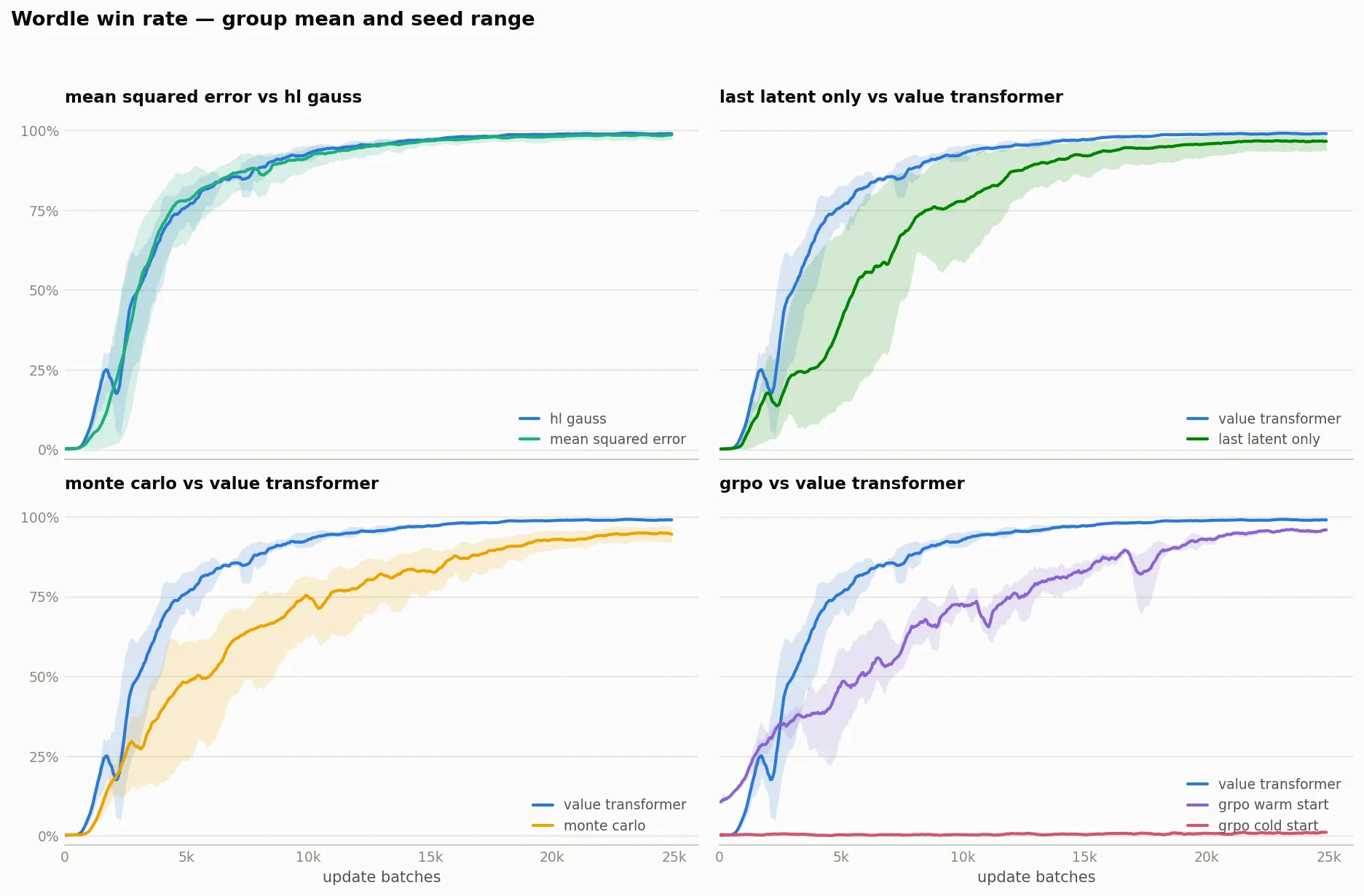
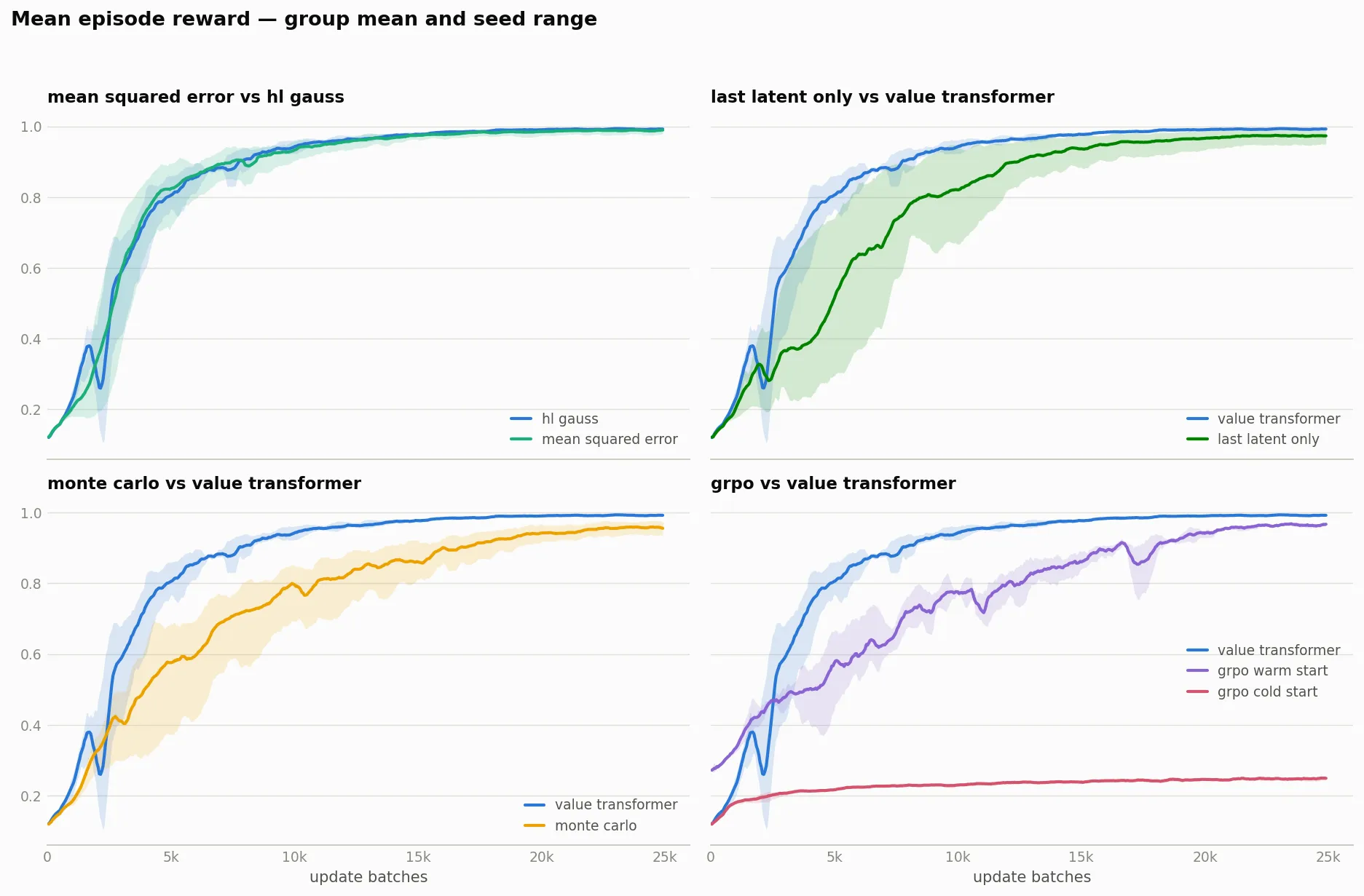
Looking at solve rate, the comparison between HL-Gauss and MSE was a null result. I was not able to reproduce the result from the Stop Regressing paper (on the same environment!).
Every model trained with the value transformer was ahead of every model trained with the last latent only (although there was one seed that came very close). The value transformer learned in a consistent band, while last-latent-only had significantly more per-seed variance. Monte Carlo learning with diverged completely in 50% of runs; here, I plotted only the survivors (3 out of 6, this config got extra seeds). GRPO from a cold start gets stuck maximizing partial-credit rewards and never learns to solve the game consistently. From a warm start, GRPO consistently learns but underperforms the value transformer.
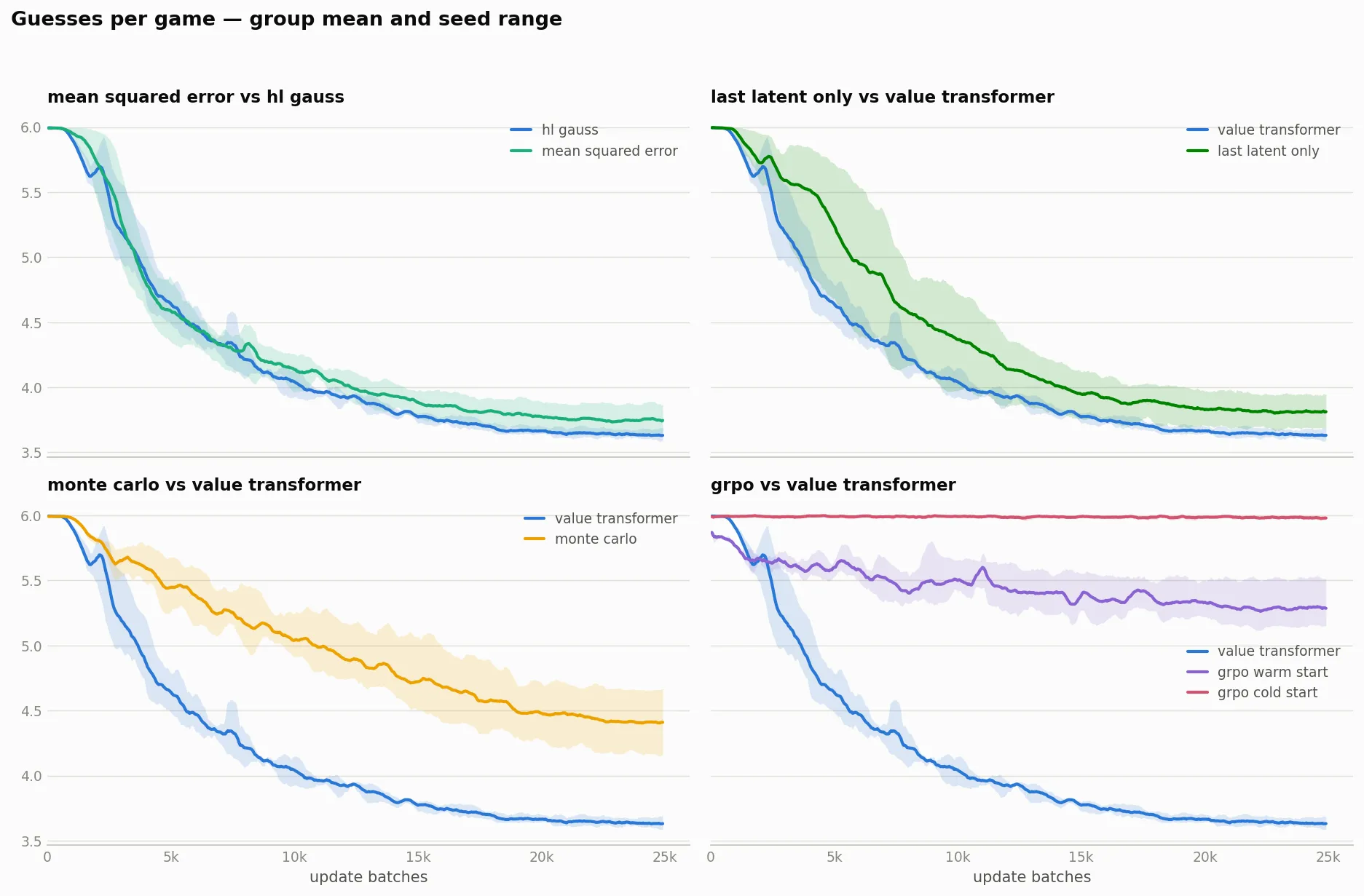
Here, when plotting turns taken per game, HL-Gauss separates from MSE somewhat, although I’m not sure whether the difference is significant. Unlike PPO, where turns taken per game decreases as solve rate increases, GRPO stays relatively steady. This reflects the fact that GRPO didn’t use discounting at turn boundaries, so it was actually incentivized to maximize information before solving the puzzle because this was the safest strategy.
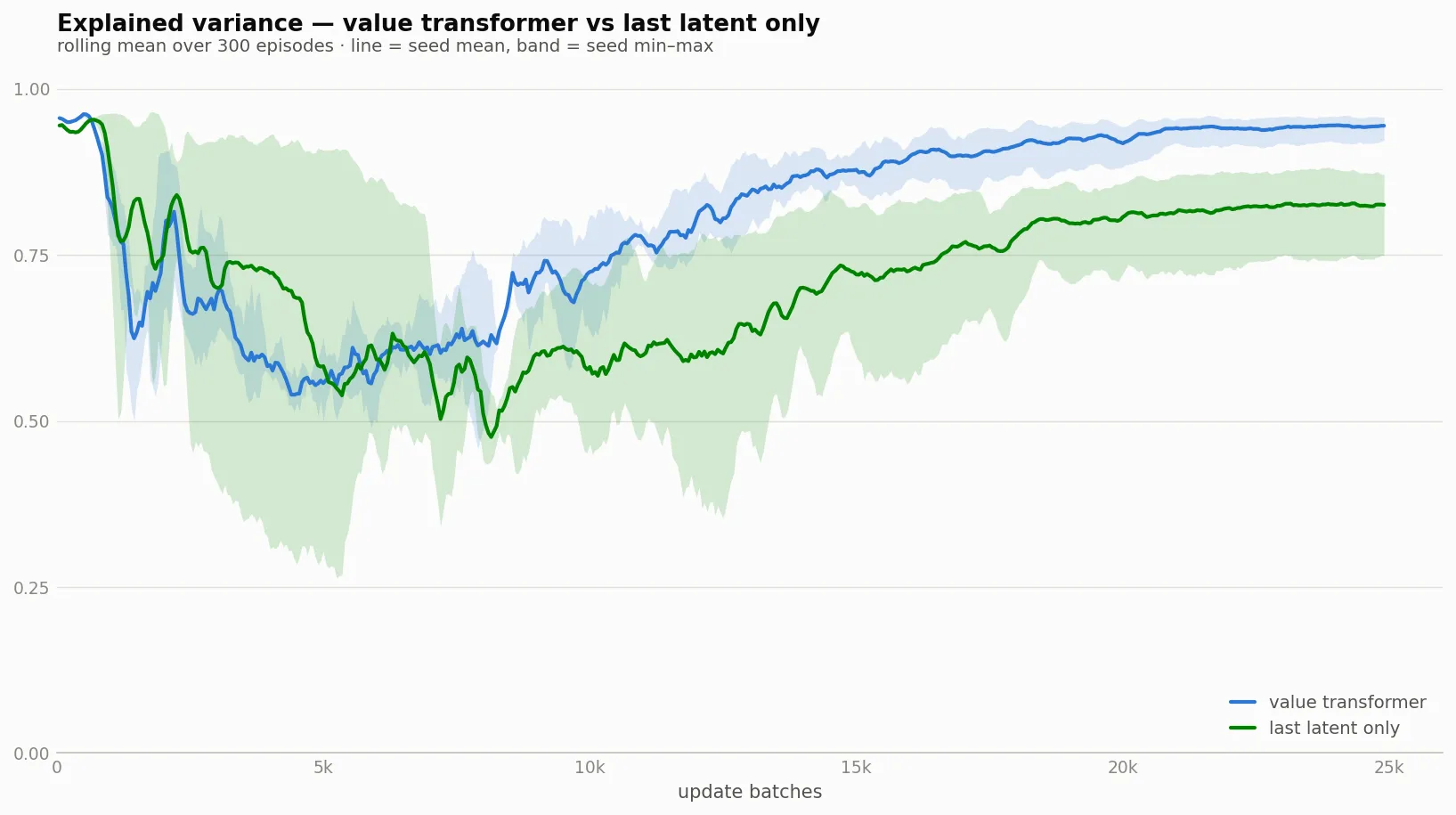
Comparing the value transformer and the last-latent-only model on explained variance, particularly at the end of training, the value transformer’s critic had much higher explained variance.
Episode patterns
Here are a few episodes from the end of value-transformer training.
You can see the value step up at the turn-level discount and step down when the partial reward is banked. The model will sometimes output no answer tokens in context before committing to an option. Notably, this context strategy resembles enumerating options under the current constraints, but they are often not real words until the model commits to a guess.
GRPO Episodes
Warm start GRPO episodes look qualitatively different, the model gathers information until the 5th or 6th guess and then often responds with the current answer, this shows the model is likely incentivized to maximize information before finishing the game since this is the safest strategy when turn discounting isn’t applied.
Next steps
While this demonstrates that value transformers can be used to fine-tune a model for Wordle, Wordle itself might differ significantly from other environments, particularly those with long context lengths. Bootstrapping needs to be demonstrated on both harder environments and with longer contexts.
The value nets for LLMs could be taken a step further by treating latent steering vectors as a high-dimensional action space rather then tokens and using a SAC-style pathwise gradient to train them. There’s some risks involved but if value functions could be used to tune models in latent space without token level loss it would be a interesting finding.
References
- LST: Ladder Side-Tuning for Parameter and Memory-Efficient Transfer Learning
- Does Representation Matter? Exploring Intermediate Layers in Large Language Models
- Stop Regressing: Training Value Functions via Classification for Scalable Deep RL
- Your Language Model is Its Own Critic: Reinforcement Learning with Value Estimation from Actor’s Internal States — POISE
- DeepSeekMath (introduces GRPO)
- What’s Behind PPO’s Collapse in Long-CoT? (VC-PPO)
- Learning Without Critics? Revisiting GRPO in Classical Reinforcement Learning Environments
- InstructGPT: Training language models to follow instructions with human feedback
- RLOO: Back to Basics — Revisiting REINFORCE-style Optimization for RLHF
- GSPO: Group Sequence Policy Optimization
- VAPO: Efficient and Reliable Reinforcement Learning for Advanced Reasoning Tasks
- AsyPPO: Asymmetric Proximal Policy Optimization — mini-critics boost LLM reasoning
- GenAC: Bringing Value Models Back — Generative Critics for Value Modeling in LLM RL